
The Market Has Changed. The Need for the Right People Hasn’t.
There is a different kind of energy in the city when the Knicks are winning. The Garden is alive, people are loud, and New York feels like itself again. For Knicks fans, these are more than game wins. It brings back decades of memory, frustration, loyalty, heartbreak, near-misses, and the kind of hope only New York sports can create.
The Knicks’ last NBA Championship came in 1973. Their last Finals appearance before this run was in 1999. The Bachrach Group was founded in 1974, just a year after that last championship, by Richard Bachrach, a New Yorker with an entrepreneurial spirit, a deep belief in relationships, and the determination to build something that could last.
So while TBG was not around to see the Knicks win it all, we have been around for almost everything that came after: the market shifts, the economic cycles, the hiring booms, the slowdowns, the comebacks, and the moments when companies had to adjust quickly to stay competitive.
In other words, we know a little something about sticking with it.
We also know how much the world of work has changed since the Knicks last reached the Finals in 1999.
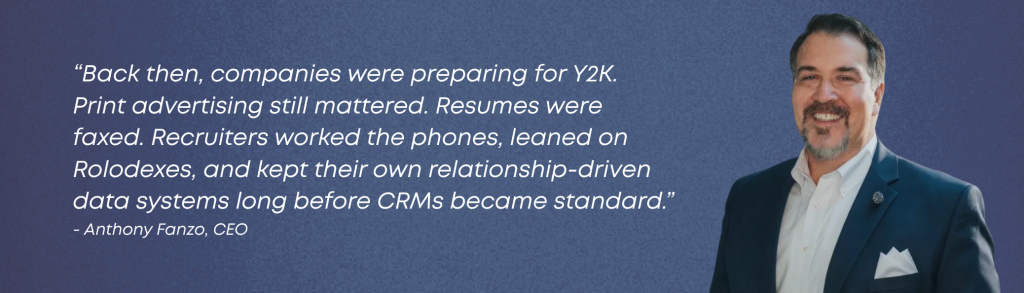
CEO, born-and-raised New Yorker, lifetime Knicks fan, and longtime technology executive recruiter Anthony Fanzo shares:
Technology roles included Y2K developers, network administrators, VoIP specialists, dial-up support, fax network administrators, systems analysts, and programmers who could help companies move safely into a new century. Employers were not always looking for the most polished resume. They were looking for people who had solved the problem before, knew the system, and could keep the business moving.
Today, technology hiring is less about surviving one major deadline and more about staying ready for constant transformation. Y2K developers have become legacy modernization experts, cloud migration leaders, systems integration specialists, cybersecurity professionals, data leaders, and AI-readiness advisors.
The vocabulary has changed, too. Automation, transformation, digital evolution, AI adoption, systems modernization – these are now everyday business priorities. But the real need underneath is familiar: companies need people who can help them adapt without losing momentum.
That same evolution has changed recruiting itself.
In 1999, finding the right person often meant doing real detective work. Recruiters built phone lists, chased down directories, mapped companies by conversation, and pieced together executive teams through persistence, referrals, and instinct. Getting to the right contact could feel like its own search before the search even began.
Today, the connections happen faster. LinkedIn, CRMs, job boards, digital outreach, AI-supported sourcing, market mapping, and virtual conversations have changed the pace of the work. A recruiter can find names faster than ever, but finding the right person still takes judgment, context, and the ability to understand what actually motivates people.
Technology has enhanced recruiting. It has not replaced it.
As Anthony explains, “Every major technology shift creates the same first reaction: people wonder what it will replace. But in my experience, the better question is what it will force us to become better at. The calculator did not eliminate accountants. It changed the way they worked. AI will do the same across industries. It will change jobs, enhance jobs, and push people to evolve.”
That evolution is already happening across the markets TBG serves. In technology, companies are hiring for modernization, security, automation, and AI readiness. In healthcare, employers need people who can navigate staffing pressure, compliance, patient access, revenue cycle complexity, and digital systems. In Real Estate and AEC, familiar titles like project manager, superintendent, engineer, and property manager now come with heavier expectations around software, cost control, sustainability, client communication, and operational strategy.
The titles may look familiar. The requirements behind them are changing quickly.
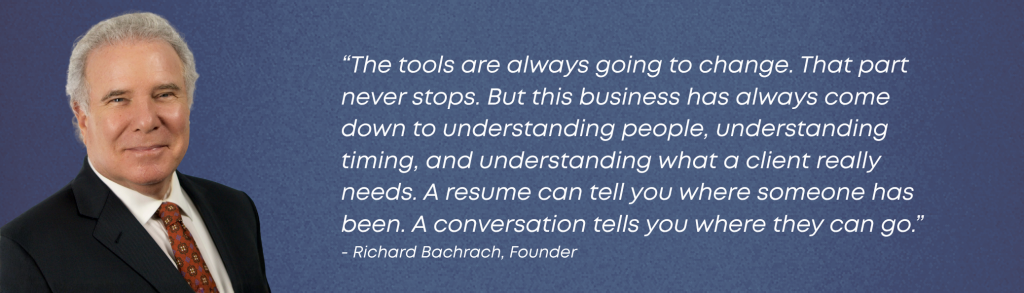
That is why strong recruiting cannot just be reactive. The best hiring partners understand where a role has been, where it is going, and what kind of person can grow with it. As Richard Bachrach puts it:
The market has changed. The titles have changed. The tools have changed. But companies still need people who can solve problems, adapt quickly, communicate clearly, and help the business move forward.
In basketball, a pivot means keeping one foot planted while changing direction. That is not a bad way to describe the best companies, the best teams, and the best recruiting partners. You need enough stability to know who you are, and enough agility to adjust when the market changes.
TBG has been doing that since 1974.
Through different economies, different hiring markets, different technologies, and different versions of New York, we have continued to help companies find the people they need to grow, adapt, compete, and win.
The Knicks are back. The city feels it.
And for us, it is a reminder of something we have always believed: winning teams are built by finding the right people before everyone else is chasing them.
New era. Same New York energy.