How Companies Are Rethinking Talent in the Age of Generative AI
By Pete Janny, Associate, EMM Research, and Audrey Symes, Partner, Head of Research
The concept of AI-assisted workflow is beginning to take hold in a significant way, as companies across industries recognize that combining AI with human capital can optimize workflows and increase their competitive edge. We are beginning to move from personal AI use to business implementation, with an AI-literate employee base.
According to a survey conducted by Ipsos and Epoch AI covering 2,000 American adults:
- 49% of AI users are using Large Language Model (LLM) systems like ChatGPT and Gemini to search the web
- Over 50% of the individuals who used AI did so for writing or editing text and brainstorming ideas
- Four out of every five users utilized AI to look up information or suggest recommendations
Given this starting point, how are companies taking the next step and developing their AI posture?
At Adobe, whose services have been in the news lately amidst the flurry of automation, product beta testing for employees has been one way to familiarize its work base with AI technologies. By letting them give feedback on technology, Adobe employees become “customer zero” for the company before products even get released to the public. Adobe, a company with over 30,000 employees, further instills this spirit of collaboration in employees through cross-functional work groups focusing on the education and implementation of generative AI across the company.
Moving across the spectrum to a company like KPMG shows meaningful attention to AI’s best practices. KPMG requires its employees to take a “Trusted AI” training program that creates awareness for the ethical standards that AI systems should be compliant with. Another one of its programs called “GenAI 101” explores AI terminology and prompt engineering, which serves to improve knowledge gaps with generative AI.
Retail workplaces are also on AI alert. American multinational clothing retailer Gap teamed with Microsoft to test how different approaches to AI adoption affect employee behaviors. They found that Gap employees who received “AI Mindset” training were twice as likely to produce high-quality work. Additionally, those who were subjected to following “rigid” AI workflows received a worse score than their counterparts who used AI intuitively. The co-analysis on generative AI found that access alone to the tools is not enough. Rather, employees benefit more from how they are trained to think and work with the models.
Companies are expected to continue their own unique initiatives as AI capabilities advance, and models continue to get smarter. For both established employees and those in the job market, employer programs will be crucial for career development, especially when paired with online certifications and higher education programs.
Even in instances where companies are lagging behind in AI technology, a curiosity to develop these capabilities is emerging with the trends. For example, an asset manager or chief investment officer who signs off on a hire may be sold on the hire’s AI skills that they themselves do not have. More than just a skillset, it becomes a competitive advantage for candidates which can lead to further upskilling once on the job.

“My conversations with internal hiring teams have touched on both the good and bad of AI, with certain answers still unknown,” says Alyson Kaye, Senior Director at The Bachrach Group. “Especially with regards to hiring managers at smaller firms, AI has given them the capability to customize their searches that otherwise wouldn’t have been possible.”
Most importantly, hiring practices themselves are being directly shaped by AI capabilities, which will ensure that AI implementation will become a pillar of workforce planning going forward. Companies are increasingly screening for AI fluency alongside traditional technical skills, and job descriptions are being rewritten to reflect new expectations around tool proficiency and adaptability. For recruiters, this shift is creating both opportunity and complexity.
EMM Research was created to extend the progression of services offered by TBG. Partner and Head of Research Audrey Symes has recently joined EMM, expanding its offerings from direct search support into broader advisory solutions, including thought leadership and customized deliverables such as case studies, industry reports, detailed topical analysis, and playbooks.
EMM Research offers services including talent analytics, compensation benchmarking, and proprietary tools like the EMM AI Impact Score and EMM Poachability Index to assess workforce resilience and risk.
EMM’s data-driven approach combines proprietary survey analysis with real-world experience to deliver tailored solutions for hiring, retention, and strategic growth.
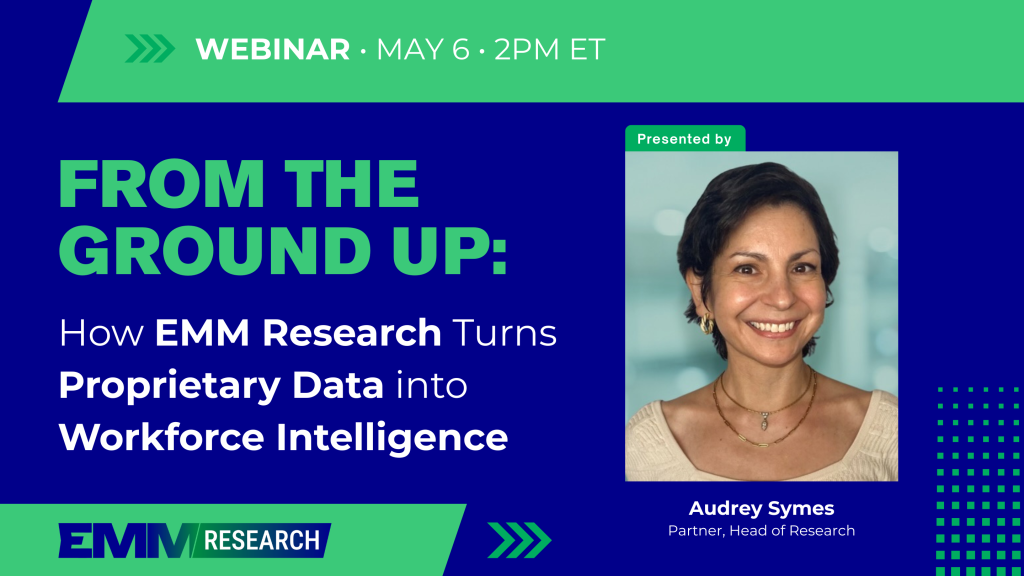
Save the date and join us for a live walkthrough of how leading financial services and CRE firms are using EMM’s full platform to make workforce decisions from a position of information advantage, and how to build compounding edge with each hire, promotion, and restructuring decision. Click here to RSVP.