Care and Construction:
The Dual Engines Powering Early 2026 Job Growth
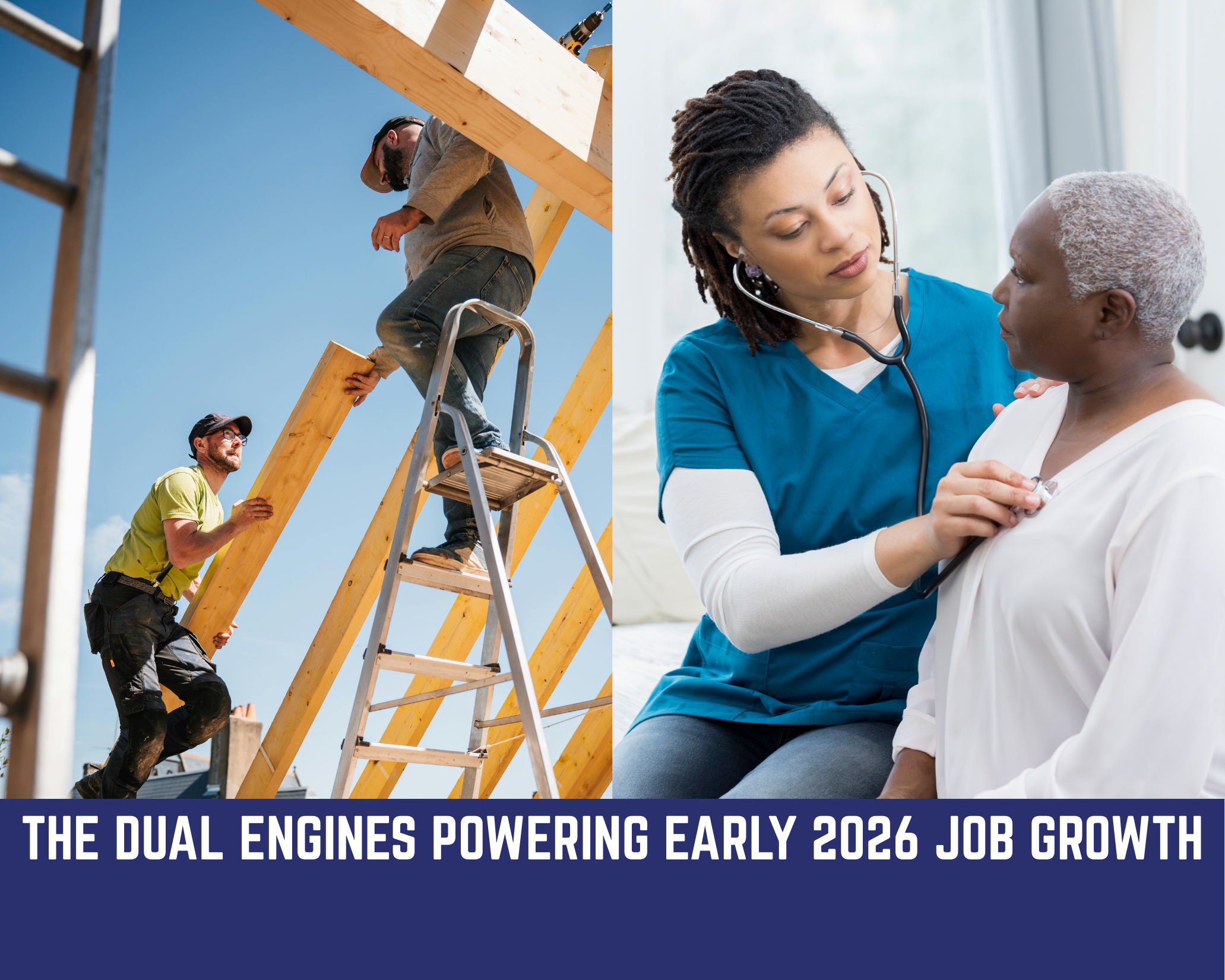
The U.S. labor market opened 2026 on a stronger-than-expected footing, adding 130,000 jobs in January and pushing the unemployment rate down to 4.3%. This payroll gain was roughly double consensus forecasts (around 55,000) and marked the highest monthly job growth since mid-2025. The surprising January surge was driven largely by robust hiring in health care, social assistance, and construction, which together accounted for virtually all the net new jobs. In fact, health care alone contributed 82,000 jobs (over 60% of the total), social assistance added 42,000, and construction grew by 33,000 positions. These official figures mirror real-world hiring trends observed by industry professionals, who report a significant uptick in recruitment across hospitals, data centers, and infrastructure projects.
The healthcare industry saw an outsized gain of 82,000 jobs in January – by far the largest contributor to the month’s employment growth. This statistical jump is playing out in real time for healthcare and social services employers.

“Over the past two months, we have seen a significant increase in hiring, largely driven by the aging population and the growing demand for healthcare workers, especially for nurses, healthcare aides, and social services. We are actively partnering with a client for their aging services programs, placing case managers, nurses, and social workers,” says Keith Olson, Managing Director
Indeed, the Bureau of Labor Statistics (BLS) reported 42,000 new jobs in the social assistance category for January, primarily in individual and family services roles that align with these trends. This momentum in health and social services hiring helped drive the overall labor market resiliency in January and reflects an emerging opportunity in these core TBG sectors.
The construction sector added 33,000 jobs in January, with robust gains among specialty trade contractors — a sign of vigorous activity in nonresidential projects like data centers and industrial facilities. Industry insiders confirm that this isn’t just a statistical blip but part of a real acceleration in project development.
 David Darby, Senior Vice President of Production, observes, “We are definitely seeing an uptick in orders, specifically around the design, development, and construction of data centers and industrial facilities,” highlighting increased investment in large-scale “mission-critical” tech and manufacturing infrastructure. Darby further notes that many AI-driven data center projects are moving “extremely fast” and clients are “staffing up earlier than usual to keep pace with aggressive schedules,” leading to a premium on experienced project managers who can oversee complex, mission-critical systems and commissioning.

This surge isn’t limited to high-tech facilities. Anthony DeVincenzo, Practice Director, adds that “we just received multiple jobs in the mission critical/data center space” and that his team is “consistently partnering with heavy civil construction companies that focus on infrastructure (roads, highways, bridges, etc.)”.
These comments point to a broad-based rise in infrastructure and construction hiring, from tech-centric data centers to traditional civil projects, which directly mirrors the BLS report’s strong construction job growth. Notably, the construction gains in January come after a period of relatively flat growth in 2025, indicating that new projects are finally ramping up after a lull, boding well for continued job creation in construction trades and project management roles as we move further into 2026.
In summary, January’s jobs report reveals early signs of rejuvenation in the labor market, led by healthcare and construction. These data align closely with what our recruiting team is witnessing on the ground, from urgent demand from hospitals for nurses and social workers to the race to staff construction projects. The current environment is characterized by “emerging opportunity,” as described by our TBG team leads; broader economic drivers such as new fiscal incentives, breakthroughs in AI productivity, and increased infrastructure investment should further bolster job creation in the months ahead.

In late 2025, Partner and Head of Research Audrey Symes joined EMM, expanding its offerings from direct search support into broader advisory solutions, including thought leadership and customized deliverables such as case studies, industry reports, detailed topical analysis, and playbooks. EMM extends the progression of services offered by The Bachrach Group by drawing on decades of successful placements and a panoramic view of operations across leading corporations to deliver strategies to unlock the full potential of its clients.
About Audrey Symes
Based in New York City, Audrey leads the development of strategy to optimize talent and operational models across the finance landscape.
Select experiences:
• Originated deep-dive subsector analysis to improve investment committee effectiveness at private equity firm Partners Group.
• Ran global advisory platform delivering tailored market entry, growth and capital deployment strategies across sectors at Jones Lang LaSalle.
• Produced quarterly economic and investment outlooks on logistics sector performance at leading global logistics REIT Prologis.
Audrey holds a BA with Honors in Economics from Stanford University and an MA in Economics from New York University. She is a member of Stanford Professionals in Real Estate (SPIRE).
To discuss how EMM can position your business optimally for 2026, please email Audrey at audreys@emmresearch.com.